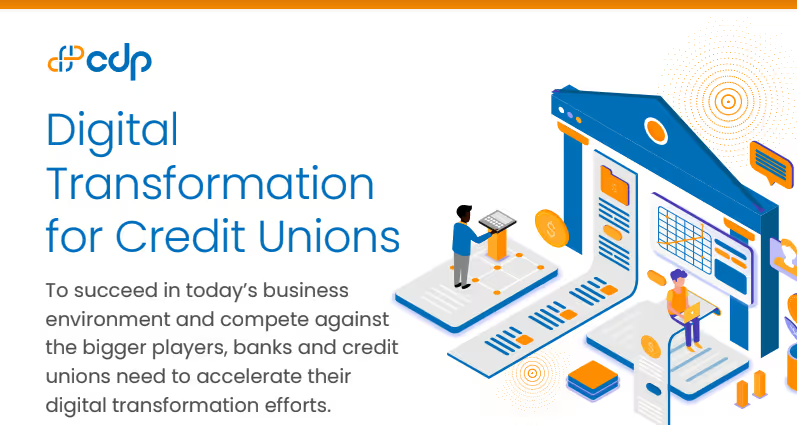
[Infographic] Digital Transformation for Credit Unions
Read More

In today’s competitive business climate, the back-office efficiency of accounts payable (AP) operations is more crucial than ever. Invoice processing, long considered a tedious and error-prone function, directly impacts cash flow, profitability, and vendor satisfaction. Yet, many organizations still rely on manual entry systems, leading to slow approvals, costly mistakes, and compliance risk. Enter artificial intelligence (AI) and advanced enterprise technologies like Laserfiche, which together offer a hybrid solution that redefines how invoice data is captured, processed, and approved. By adopting AI-powered invoice data extraction coupled with Laserfiche’s adaptable workflow automation, businesses can remove historical bottlenecks, drive down operating costs, and gain new visibility into their payables cycle. This article explores why now is the time to embrace intelligent automation for invoice processing—and how to do it right.
Many organizations handle thousands of invoices monthly, each requiring precise data entry, validation, and approval. When performed manually, this process becomes a minefield for errors and inefficiencies. Staff must review documents, transcribe information into ERP systems, and chase down approvals. The results? Significant time is lost to repetitive tasks, which not only strains payroll budgets but also reduces employee morale as talent gets bogged down in low-value activities. Add to this the danger of mistakes—such as entering incorrect amounts, misallocating vendor details, or mistyping invoice numbers—and even small errors can snowball into payment delays or compliance violations. Moreover, physical invoice processing constrains remote work capabilities, exposes sensitive information to risk, and hampers an organization’s ability to respond rapidly to audit requests or regulatory updates. In the end, paper-driven and manual digital workflows leave little room for strategic growth or process improvement.
AI-driven technologies have transformed how we approach document management. Innovations like Optical Character Recognition (OCR) and machine learning algorithms enable businesses to lift invoice details—such as vendor names, invoice numbers, dates, and amounts—directly from scanned images or digital files with incredible accuracy. When trained on hundreds of invoice templates, machine learning models become adept at interpreting different formats and flagging anomalies. The result is a leap in processing speed, as hours-long manual tasks are compressed into seconds. Further, AI continuously improves as it processes more invoices, adapting to new layouts and evolving business needs. These technologies empower organizations to process spikes in invoice volume—whether from business growth or seasonal cycles—without hiring additional staff. Data quality improves and compliance risks decrease, laying a strong foundation for downstream automation and analytics.
While AI extracts and structures invoice data with speed and precision, the next step is workflow automation. Laserfiche stands out as an enterprise content management platform specializing in business process automation. By integrating AI-extracted invoice data into Laserfiche workflows, organizations can fully automate how invoices are handled, routed, and archived. For example, incoming invoices can be automatically categorized based on value or department, then routed via predefined rules to relevant stakeholders for review and approval. Integration with core ERP or financial systems ensures that approved invoice data populates accounting records instantly, eliminating redundant data entry. Laserfiche also delivers robust compliance features, such as audit trails and access controls, providing transparency and security for sensitive payment information. Notifications and reminders guarantee that invoices are processed against deadlines, reducing late payment penalties while promoting strong vendor relationships. The modularity of Laserfiche workflows allows finance leaders to adapt to organizational changes or regulatory updates without major IT overhauls.
The real-world impact of combining AI and Laserfiche is dramatic. Organizations equipped with this automation have reported reductions in invoice processing times of up to 70%. This accelerated throughput enables finance teams to seize early payment discounts, resolve issues before they escalate, and focus on strategic analysis rather than clerical work. Automation significantly lowers payroll and operational expenses by removing manual touchpoints, while minimizing costly errors and the risks of regulatory non-compliance. Vendors benefit as well: prompt processing ensures steady cash flow for suppliers, fostering goodwill and potential preferential treatment in future negotiations. Meanwhile, management teams access up-to-the-minute data on payables activity, gaining new power to forecast cash requirements, identify process bottlenecks, and optimize financial strategies. The cumulative effect is a more agile, resilient AP operation delivering powerful ROI.
Several converging trends make this the ideal moment for organizations to modernize invoice processing with AI and Laserfiche. First, invoice volumes are rising as businesses expand and diversify suppliers; manual processes simply cannot keep pace at scale. Second, remote and hybrid workforces demand cloud-based, automated solutions—not paper-bound approvals or location-restricted systems. Third, the regulatory environment is growing more complex. Staying audit-ready and secure requires strong digital controls and transparent processes, which automation readily provides. Finally, the competitive value of innovation is clear: companies that digitize their AP cycle quickly gain efficiency, reduce costs, and position themselves as strategic partners internally and with suppliers. With the out-of-the-box integration between AI and Laserfiche automation, even mid-sized organizations can implement world-class invoice processing in weeks instead of years. The barriers to entry have never been lower, and the rewards have never been greater.
The accounts payable function is ripe for transformation. Traditional manual processes result in slow payments, costly data errors, and persistent compliance headaches. AI-powered invoice data extraction, working in conjunction with Laserfiche’s dynamic workflow automation, offers a proven solution—one that brings operational speed, cost savings, and confidence in regulatory compliance. By adopting these technologies now, organizations not only fix today’s pain points but also future-proof their finance operations for new business models, growth, and the demands of a distributed workforce. The journey to world-class AP performance begins with a single step: leveraging AI and Laserfiche to turn complexity and chaos into streamlined, actionable workflows. If your business is seeking measurable value and transformation in accounts payable, AI and Laserfiche offer a clear path forward. Start your automation journey today to unlock efficiency, accuracy, and growth like never before.
How does AI-powered data extraction work with Laserfiche? AI uses machine learning to extract invoice information, then Laserfiche routes and manages these invoices automatically using workflow automation tailored to your business needs.
What types of invoices can AI and Laserfiche process? These systems can handle invoices of various formats, including PDFs, scanned images, electronic documents, and even handwritten notes, learning from each type to improve accuracy.
Is it difficult to implement AI-powered automation with Laserfiche? Modern integrations and cloud solutions mean most organizations can deploy these technologies much faster than traditional IT projects, with many seeing results in weeks.
Can Laserfiche automate other financial processes? Yes, Laserfiche can be configured to automate a wide variety of finance functions beyond invoice processing, including onboarding, procurement, and compliance tracking.
What are the security and compliance benefits? Laserfiche provides robust audit trails, role-based access, and industry-standard encryption, helping ensure compliance with financial regulations and data privacy standards.
How do these solutions deliver ROI? By reducing manual processing times, eliminating errors, and increasing staff productivity, organizations can see substantial cost savings and reduce financial risk.
.avif)