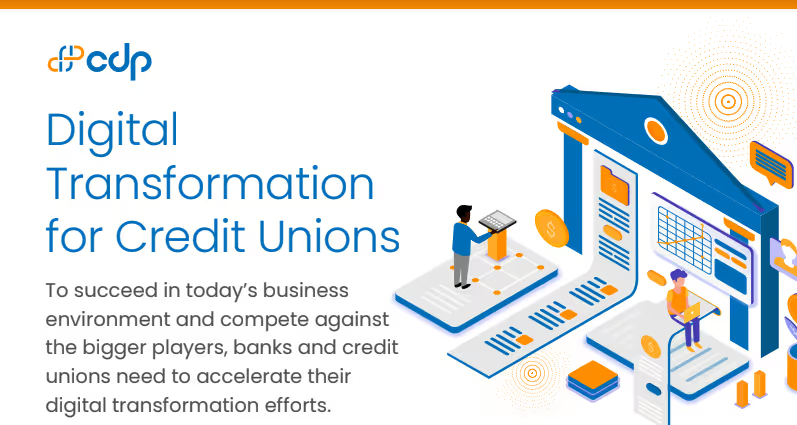
[Infographic] Digital Transformation for Credit Unions
Read More

Rapid innovation and intensifying competition mean that organizations can no longer afford to waste time or resources on manual, paper-driven business processes. The drive toward digital transformation has become an urgent priority across sectors looking to improve productivity, reduce overheads, and respond swiftly to market changes. At the heart of this revolution is Digital Process Automation (DPA), a technology approach that equips organizations to automate end-to-end business workflows with speed and agility. While traditional process automation has its merits, it often demands custom coding, extended timelines, and significant IT resources. Today, modern tools are enabling a much-needed shift: no-code digital process automation platforms like Laserfiche are democratizing automation, putting the power to design, optimize, and scale business processes directly into the hands of business users. This article explores what DPA really means, how it rises above legacy business process automation, and why Laserfiche's no-code approach is a game-changer for organizations aspiring to modernize, empower their workforce, and position themselves for enduring success.
Digital Process Automation (DPA) goes far beyond simple task automation. It encompasses the use of modern digital technologies to transform workflow processes from end to end—capturing data, enabling seamless collaboration, automating routine actions, and delivering actionable insights through advanced analytics. DPA focuses on the holistic digitization and integration of workflows, making them more agile, adaptive, and intelligent. While Business Process Automation (BPA) typically concentrates on automating individual tasks or discrete components, DPA takes a broader view, connecting systems, people, and data sources to optimize entire value chains. Artificial intelligence, machine learning, cloud computing, and intuitive user interfaces are core elements that help make DPA highly effective and accessible. Perhaps most notably, DPA solutions like Laserfiche are designed for non-technical users. They feature visual, drag-and-drop builders and preconfigured templates, slashing both the time and cost typically associated with conventional automation projects. This democratization means that department leaders, subject matter experts, and even frontline staff can quickly digitize paper processes and build robust workflow automations tailored to evolving business needs—all without writing a single line of code.
Laserfiche stands at the forefront of no-code digital process automation, equipping businesses with robust tools to accelerate their transformation journeys. Its platform has been crafted for ease, flexibility, and scalability, making it ideal for organizations at any stage of digital maturity. Let's dive into the three primary ways Laserfiche's no-code capabilities are revolutionizing workflow efficiency:
1. Rapid Automation of Paper-Based Tasks
Despite the push toward digital transformation, many organizations still rely heavily on paper forms, manual approvals, or traditional document routing. These processes slow down operations, contribute to errors, and limit transparency. Laserfiche addresses this gap with its comprehensive suite of document and workflow automation tools. Users can digitize physical documents with integrated scanning, extract critical data, and instantly embed that information into automated workflows. The platform's intuitive drag-and-drop workflow designer allows any business user—not just IT professionals—to create, modify, and launch automated solutions for tasks like invoice processing, contract management, employee onboarding, and more. What once took weeks of development can now be deployed in a matter of hours, unlocking agility and freeing up teams for more strategic initiatives.
2. Enhanced Process Visibility and Control
Effective automation is not just about moving tasks more quickly. For true operational excellence, organizations need real-time insights and granular control over every step of the process. Laserfiche provides robust dashboards and dynamic audit trails, giving process stakeholders visibility into workflow statuses, pending approvals, bottlenecks, and compliance metrics. Detailed reporting and analytics help both managers and individual contributors pinpoint areas for continuous improvement, optimize resource allocation, and ensure consistent adherence to policies and regulations. The ability to track actions, document changes, and receive notifications in real time translates to greater accountability, improved compliance, and a culture focused on results and transparency.
3. Scalable Solutions for Growth and Change
As organizations expand, so do their business processes. Scaling traditional automation systems can be cumbersome, often requiring significant redevelopment or complex integrations. Laserfiche's cloud-native architecture and modular design remove these barriers, making it easy to add new workflows, connect with third-party applications, and scale up to accommodate more users or growing data volumes. Its flexible APIs and marketplace of prebuilt integrations empower organizations to connect Laserfiche with other systems in their environment—be it CRM, ERP, or analytics platforms. Teams can collaborate across geographies, automate cross-functional processes, and rapidly adapt as new business challenges or opportunities arise. This built-in scalability is especially valuable for growing organizations looking to future-proof their operations without frequent overhauls or disruptive migrations.
Laserfiche’s no-code digital process automation unlocks transformative benefits for organizations of all sizes and industries. Here are some of the most significant outcomes:
Laserfiche’s versatility makes it suitable for a vast range of departments and industries. Here are just a few examples of how organizations are leveraging its no-code capabilities:
The future of work lies in agile, connected, and efficient processes—qualities made possible through digital process automation. As organizations grapple with evolving customer expectations, compliance demands, and the pressure to innovate faster, no-code solutions like Laserfiche offer a proven path forward. By removing technical barriers, democratizing workflow design, and ensuring visibility and control at every stage, Laserfiche enables businesses to unlock new levels of productivity and transparency. Whether digitizing core administrative processes or transforming enterprise-wide operations, the impact is clear: less time wasted on manual tasks, greater focus on strategic goals, and the adaptability necessary to thrive in a rapidly changing environment. For organizations striving to future-proof their processes, Laserfiche’s no-code automation is more than a tool—it is a catalyst for sustainable growth and operational excellence.
What is digital process automation?
Digital process automation refers to leveraging digital tools and platforms to automate, optimize, and integrate business workflows, improving efficiency and transparency while reducing manual errors.
How is Laserfiche different from traditional automation solutions?
Unlike traditional systems that require custom coding and IT expertise, Laserfiche offers a no-code, drag-and-drop interface that empowers business users to quickly build, deploy, and modify automations with minimal technical support.
What types of processes can be automated with Laserfiche?
Nearly any repeatable process can be automated, including HR onboarding, invoice processing, contract management, compliance tracking, and customer service workflows.
Can Laserfiche integrate with other business systems?
Yes, Laserfiche features flexible integration capabilities and prebuilt connectors for CRM, ERP, analytics tools, and more—helping organizations maximize the value of their existing technology stack.
Is Laserfiche suitable for small and mid-sized organizations?
Absolutely. Laserfiche is designed to scale from small departments to large enterprises, with cloud-based solutions and pricing models that suit organizations at any stage of growth.
What are some first steps in adopting Laserfiche digital process automation?
The journey often begins by identifying paper-heavy or repetitive processes, digitizing documents, and collaborating with key stakeholders to map, design, and launch an initial automation using Laserfiche’s no-code builder.
.avif)