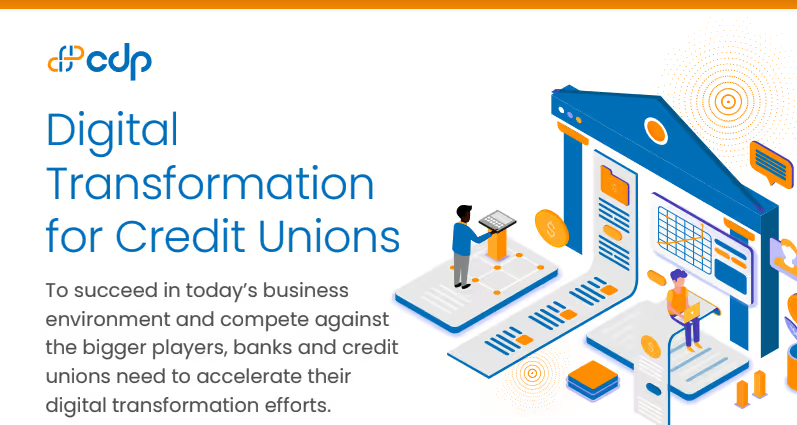
[Infographic] Digital Transformation for Credit Unions
Read More


The banking industry is undergoing a transformative journey, driven by the rapid pace of digital evolution. In this dynamic environment, data handling and accuracy have emerged as critical components. With the integration of digital solutions, banking practices are becoming more precise, efficient, and reliable, significantly reducing the risks associated with human errors and inaccuracies in data management. This article delves into the role of digital innovations in enhancing data accuracy within the banking sector.
Artificial Intelligence and Machine Learning have emerged as pivotal forces in revolutionizing data accuracy in banking. Machine Learning, a branch of AI, empowers machines to enhance their decision-making capabilities over time. By analyzing vast datasets, ML algorithms provide insights that minimize errors and facilitate better decision-making in banking operations. This leads to more accurate risk assessments, fraud detection, and personalized customer experiences.
Blockchain technology stands as a beacon of trust and transparency in banking operations. By providing a decentralized ledger for recording transactions, blockchain eliminates the potential for data manipulation, fraud, or duplication. This not only ensures data accuracy but also bolsters customer confidence in the security and transparency of their transactions. Blockchain's immutable nature makes it an invaluable tool for enhancing data integrity in the banking sector.
Robotic Process Automation (RPA) is transforming how banks handle data-intensive tasks. By automating repetitive processes such as data entry, extraction, and processing, RPA increases processing speed and eliminates the possibility of human error. This automation not only enhances data accuracy but also frees up human resources to focus on more strategic and value-added activities, ultimately improving overall operational efficiency.
Cloud computing has revolutionized data storage and accessibility in the banking sector. By providing secure and scalable storage solutions, cloud technology enables banks to store vast amounts of data safely. The ability to quickly process and retrieve data ensures that both customers and bank staff have access to accurate information at any time. This seamless access to data enhances decision-making processes and contributes to a more agile and responsive banking environment.
The advent of digital solutions such as AI, ML, Blockchain, RPA, and Cloud Computing has undeniably enhanced data accuracy in the banking sector. By leveraging these technologies, banks can not only increase data precision but also improve processing speed, enhance operational efficiency, and meet the ever-growing industry standards and customer demands. As the banking landscape continues to evolve, it is imperative for financial institutions to prioritize digital solutions for better data accuracy. This commitment to digital transformation will pave the way for continued growth, increased customer trust, and a more robust and efficient banking system for the future.
Q: How does AI contribute to data accuracy in banking?
A: AI, particularly through Machine Learning, analyzes large datasets to provide insights that minimize errors and improve decision-making, leading to more accurate risk assessments and fraud detection.
Q: What role does Blockchain play in ensuring data accuracy?
A: Blockchain provides a decentralized ledger that eliminates data manipulation, fraud, and duplication, ensuring data integrity and enhancing customer trust in banking operations.
Q: How does RPA improve data accuracy in banking?
A: RPA automates repetitive tasks such as data entry and processing, increasing speed and eliminating human error, thus enhancing data accuracy and operational efficiency.
Q: Why is cloud computing important for data accuracy in banking?
A: Cloud computing offers secure and scalable storage solutions, enabling quick data processing and retrieval, ensuring that accurate information is accessible to both customers and bank staff at any time.
.avif)