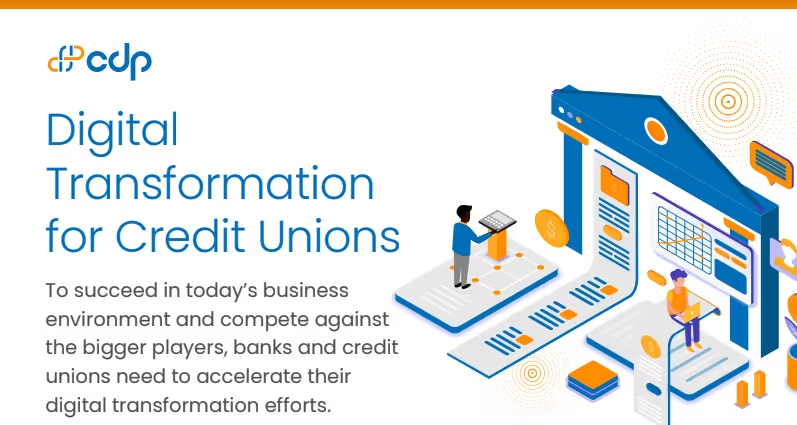
[Infographic] Digital Transformation for Credit Unions
Read More

In a rapidly evolving business landscape, efficiency, accuracy, and speed have become the defining benchmarks of organizational success. Companies are consistently under mounting pressure to streamline their operations, reduce costly errors, and deliver measurable outcomes more swiftly. Enter digital process automation—a strategic technology that transcends traditional automation by enabling end-to-end optimization of complex, multi-step processes across departments. For organizations burdened by paper-driven systems and manual interventions, digital process automation (DPA) offers a vital pathway to higher productivity and operational agility. Among the industry’s leading DPA solutions, Laserfiche stands out by offering powerful no-code tools that empower users of all technical skill levels to automate and optimize business workflows. This article delves into the core concepts of digital process automation, addresses the pressing challenges of paper-based procedures, and highlights how Laserfiche’s no-code tools are revolutionizing the way organizations operate—driving efficiency, transparency, and scalability like never before.
Digital process automation, often referred to simply as DPA, is a transformative approach to business process management that leverages digital tools to automate complex workflows. While traditional task automation might focus solely on individual routine jobs, DPA orchestrates interconnected systems, diverse data sources, and user interactions to enable end-to-end process improvements. The primary goal extends beyond relieving workers of repetitive tasks; it is about optimizing the journey of work, ensuring every stage is seamlessly linked, highly visible, and continuously streamlined. Many processes are ideal candidates for DPA, such as invoice approvals, contract management, regulatory compliance tracking, employee onboarding, and records management. By digitizing these processes and automating critical steps, organizations can achieve notable improvements in accuracy, speed, and compliance. Perhaps most importantly, digital process automation transforms operational models by reducing workflow bottlenecks, lowering operational costs, and liberating personnel to concentrate on higher-value strategic initiatives. Businesses deploying DPA are better positioned to adapt to market changes, meet customer expectations, and maintain a competitive edge in today’s increasingly digital environment.
Despite advances in technology, a significant number of organizations continue to rely on manual, paper-based workflows. These legacy processes are fraught with inefficiencies: physical documents are prone to being misplaced or delayed, approvals can languish as they await manual signatures and handoffs, and establishing a clear audit trail often becomes a daunting challenge. The consequences are more than just operational headaches—paper-based workflows contribute to costly errors, extended cycle times, difficulties in regulatory compliance, and increased risk of lost or incomplete data. As organizations expand, these challenges are only magnified, with the volume of documents and transactions overwhelming even the most diligent teams. The lack of real-time process visibility can make it nearly impossible for managers to identify bottlenecks or implement improvements that increase productivity. Additionally, paper-bound procedures inherently limit collaboration, making it difficult for remote teams or geographically dispersed offices to participate effectively in a process. The imperative is clear: to stay competitive, organizations must replace their paper-based systems with flexible, automated digital solutions.
Laserfiche has redefined the landscape of digital process automation by providing a no-code platform that enables business users, regardless of their technical background, to design, deploy, and enhance automated workflows. The democratization of automation offered by Laserfiche accelerates digital transformation across sectors. Here is how Laserfiche stands at the forefront of business process optimization:
Rapid Automation of Paper-Based Tasks: Laserfiche combines intuitive document capture and digital forms to seamlessly convert paper-driven tasks into fully digital workflows. Users quickly scan, upload, and index documents, then design automated routes for review and approval based on business rules, all without coding. For example, an invoice received by mail can be digitized, automatically routed to the appropriate department for approval, and recorded in the necessary financial systems—eliminating needless manual handling.
Improved Process Visibility: The Laserfiche platform provides robust analytics and dashboard capabilities that offer real-time insights into workflow performance. Managers can see where every task stands, identify slow points, and easily track compliance checkpoints. This transparency enables leadership to make data-driven decisions, intervene proactively when bottlenecks occur, and foster a culture of continuous improvement.
.avif)