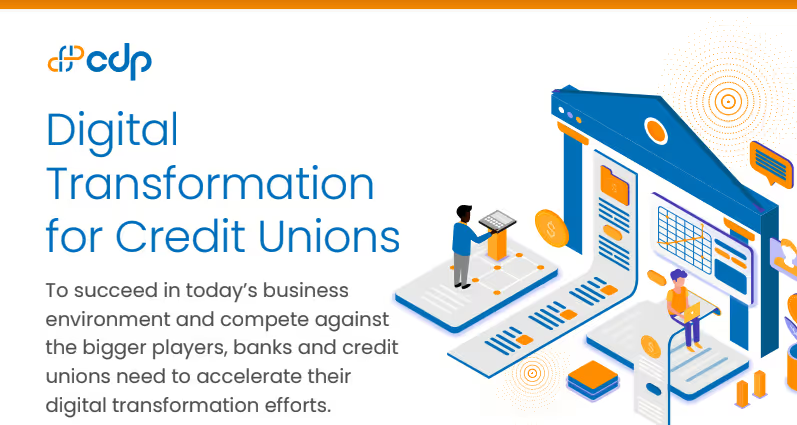
[Infographic] Digital Transformation for Credit Unions
Read More

In our digitally driven world, organizations face an ever-growing torrent of information arriving in myriad forms—scanned images, paper documents, PDFs, and handwritten notes. The challenge is not only storing these materials but making the valuable information they contain readily accessible and usable. This is where Optical Character Recognition, or OCR, plays a pivotal role. OCR technology allows organizations to bridge the gap between paper-based content and the digital workflows necessary for agility and competitiveness. However, not all OCR solutions are created equal. Laserfiche, a leader in enterprise content management (ECM) and workflow automation, stands out with its seamlessly integrated, highly accurate OCR capabilities. But what does this mean for modern organizations seeking to extract value from their content? This article delves into the core concepts of OCR, details how Laserfiche leverages this advanced technology, and highlights the real-world impact of turning static images into searchable, editable text.
Optical Character Recognition (OCR) is a sophisticated technology that converts text within images, scanned papers, or digital photos into machine-readable and editable text. Imagine having a stack of paper forms, employee contracts, or financial invoices. Traditionally, these would have required manual data entry—a laborious and error-prone process. With OCR, the process of data capture is automated. The software scrutinizes each character on the page, intelligently distinguishing between fonts, cases, and sometimes even handwriting, and reproduces them as digital text that computers can process.
The implications extend beyond mere convenience. OCR democratizes access to information by transforming locked or static data into searchable, actionable digital assets. For organizations, this means they can reduce human error, accelerate workflows, and foster a paperless environment. This foundational technology underpins the modern drive toward digital transformation, making content findable, editable, and ready for analysis in seconds instead of hours or days.
As more industries digitize their records, OCR technology is no longer a luxury but a necessity. Whether processing mailroom correspondence, onboarding new clients, or complying with regulatory audits, organizations need fast, accurate access to information. OCR stands at the heart of this evolution, and leaders like Laserfiche are redefining what’s possible within enterprise document management.
Improved Efficiency: Instead of spending countless hours on manual data entry, employees can redirect their focus to higher-value tasks. Automated text extraction slashes response times and drives productivity, translating directly into faster client service and more agile operations.
Enhanced Data Accessibility: Once content is digitized via OCR, retrieving specific documents or searching for critical terms becomes instantaneous. Imagine a vast digital filing cabinet where you can locate any contract, invoice, or correspondence in a fraction of a second.
Cost Savings: Physical document storage and manual handling carry ongoing expenses. With OCR and robust document management from Laserfiche, organizations cut these costs while minimizing the risk of lost or misfiled records. The result is not only financial savings but also peace of mind.
Unmatched Accuracy: State-of-the-art OCR software now rivals, and in some cases surpasses, human transcription accuracy. Laserfiche’s advanced algorithms recognize everything from crisp print to challenging handwritten notes, ensuring reliable data extraction even from complex layouts.
Regulatory Compliance and Auditability: Electronic records simplify compliance with retention rules and legal regulations. With digitized, text-searchable files, maintaining audit trails and demonstrating compliance during an inspection or audit is significantly streamlined.
Collectively, these benefits drive substantial operational improvements and empower teams across legal, healthcare, finance, and government sectors.
Laserfiche’s built-in OCR solution is purpose-designed to integrate seamlessly within its Enterprise Content Management and workflow automation platform. There’s no need for complex third-party integrations or manual intervention. Here’s what sets Laserfiche OCR apart:
Seamless Integration: As part of the Laserfiche ecosystem, OCR operates behind the scenes, capturing data from scanned documents the moment they enter the system. This tight integration enables true straight-through processing: a user starts with a scanned file and, in moments, obtains a digital record ready for indexing or workflow automation.
High Accuracy and Flexibility: Laserfiche harnesses the latest OCR algorithms to accurately recognize a broad range of text styles, layouts, and document formats—even when handed pages that include handwritten notations or complex forms. This means less manual correction and higher trust in the extracted data.
Keyword Search and Text Editing: Once processed, every word within the scanned file becomes searchable and, if needed, editable. Users can search thousands of stored documents for a specific name, client number, or keyword, instantly retrieving pertinent information from the deepest reaches of their repository.
Workflow Automation: The real power of OCR in Laserfiche is unleashed through automated business processes. Extracted data enables automatic classification, metadata tagging, and even the intelligent routing of documents—greatly reducing approval wait times and administrative backlogs.
Laserfiche OCR doesn’t just make your documents digital; it makes your information dynamic and actionable.
Across industries, Laserfiche OCR is revolutionizing daily operations, empowering organizations to achieve more with less effort. Consider these examples:
Legal Sector: Law firms rely on timely access to contracts, case files, and correspondence. Laserfiche OCR allows teams to digitize and index thousands of pages, making legal research and case preparation more efficient than ever. Paralegals and attorneys quickly retrieve essential clauses or terms from decades-old scanned agreements, accelerating client service and case turnaround.
Healthcare Providers: Hospitals and clinics face enormous paper trails: intake forms, medical records, prescriptions, and consent documents. Digitizing these with Laserfiche OCR supports rapid file retrieval, reduces the risk of lost records, and improves patient care coordination, all while protecting privacy and compliance with healthcare regulations.
Finance and Accounting: Processing invoices, receipts, and financial statements becomes effortless as OCR extracts numerical data and key details. This enables rapid digital archiving, automatic matching to existing transactions, and hands-off routing for payment approvals, shrinking cycle times and reducing costs.
Government Divisions: Public agencies managing permits, citizen records, or historic archives can digitize volumes of paperwork, ensuring these assets are not only preserved but also quickly located and shared for transparency and timely service delivery.
These examples barely scratch the surface of how Laserfiche OCR can be tailored to unique business challenges, unlocking new efficiencies with each deployment.
Optical Character Recognition is not just a technical convenience—it’s a foundational piece of a modern, agile, and intelligent information management strategy. Today, the demand for instant, reliable access to business-critical data has never been greater. Laserfiche’s built-in OCR capabilities deliver on this demand by transforming static, inaccessible documents into assets that drive workflow automation, enhance compliance, and slash operational inefficiencies.
For organizations looking to move beyond the limitations of manual document handling or siloed data, adopting Laserfiche OCR is a strategic next step. The benefits—greater productivity, error reduction, rapid information retrieval, and seamless integration with existing workflows—are felt across every level of the enterprise.
Yet, the potential for OCR technology within Laserfiche continues to expand. As AI and machine learning fuel even greater accuracy and new applications, organizations embracing this technology now will be best positioned to adapt to the information challenges of tomorrow. Don’t just digitize—unlock your information’s full potential with Laserfiche OCR, ensuring your content is not only stored but transformed into a competitive advantage.
What is OCR and why is it important? OCR, or Optical Character Recognition, converts text in scanned images and documents into searchable, editable digital text. It enables rapid data access, automation, and reduces manual data entry workload.
How does Laserfiche differentiate its OCR from other solutions? Laserfiche OCR is integrated into the document management platform, requires no third-party add-ons, and uses advanced algorithms to ensure high accuracy, supporting a variety of document types and handwriting.
Can Laserfiche OCR handle handwritten documents? Yes, Laserfiche OCR is designed to recognize both printed and many handwritten texts, making it an effective tool even for documents with mixed content.
Is the text output from Laserfiche OCR fully editable? Absolutely. Once processed, the scanned content becomes both searchable and editable, which allows for easy updates and repurposing.
What are common business applications for Laserfiche OCR? Laserfiche OCR is widely used in legal case research, patient records management, automated invoice processing in finance, and making government records more accessible and transparent.
How does OCR contribute to workflow automation? OCR extracts data that triggers workflow actions: auto-filing, indexing, document routing, and more, saving time and improving operational accuracy.
.avif)