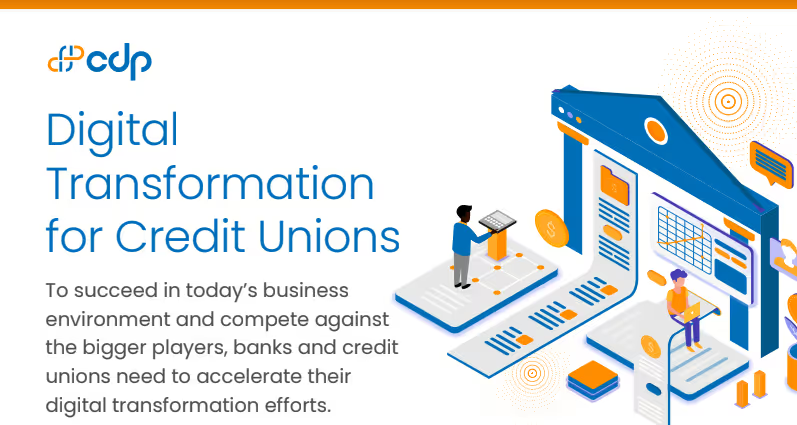
[Infographic] Digital Transformation for Credit Unions
Read More

In a world where information is growing exponentially, the ability to manage and retrieve data efficiently is a strategic advantage. Organizations, whether large or small, are constantly seeking solutions to streamline their document workflows and eliminate tedious manual processes. One technology at the heart of this transformation is Optical Character Recognition (OCR). OCR has revolutionized the way we interact with documents, making it possible to digitize, search, and edit content once locked away within paper files or static images.
At the forefront of this innovation is Laserfiche, a leading enterprise content management solution. By embedding powerful OCR capabilities into its platform, Laserfiche provides organizations with game-changing tools to capture, convert, and leverage their information assets more effectively. This article explores what OCR is, how it works, and how Laserfiche's OCR technology enables organizations to boost efficiency, optimize workflows, and enhance data accessibility.
Optical Character Recognition, or OCR, refers to technology that reads and identifies printed or handwritten text in images, scanned documents, or PDFs, converting it into machine-readable and editable text files. This process bridges the gap between analog and digital data, allowing organizations to move away from reliance on paper and static images toward actionable, dynamic content.
OCR is widely used in everyday scenarios: digitizing books and archival materials for libraries, extracting key financial data from invoices, pulling contact information from business cards, and automating forms processing in a variety of industries. By making this content digitally accessible, OCR eliminates the need for laborious manual typing and paves the way for robust data analytics, search, and automation.
The accuracy and speed of OCR have improved dramatically thanks to advancements in artificial intelligence, machine learning, and image processing. Today’s OCR tools, including those built into Laserfiche, are capable of handling diverse document types, languages, and complex formatting with impressive reliability.
OCR is a sophisticated process relying on a blend of computer vision, pattern recognition, and linguistic analysis. The workflow typically involves several interrelated steps:
1. Image Preprocessing: Enhancements such as adjusting brightness, removing visual noise, and correcting distortions set the stage for accurate character analysis.
2. Text Detection: The system identifies the presence and location of text blocks to focus on for recognition.
3. Character Segmentation: Each character, word, or line is isolated, a critical step for distinguishing between similar-looking shapes and adjacent letters.
4. Character Recognition: Techniques such as neural networks compare shapes against libraries of known characters, assigning matches even in cases of varied fonts or handwriting.
5. Post-Processing: The recognized text is refined through contextual analysis, spell-checking, and user feedback. Errors are minimized by cross-referencing with dictionaries or specialized databases.
With the evolution of machine learning, OCR systems now not only recognize more types of data but also learn to improve their accuracy with continued use. Technologies like Laserfiche’s OCR capitalize on these advancements by delivering consistently high-fidelity results, even on challenging, low-quality scans or documents with mixed languages and complex layouts.
Laserfiche stands out in the crowded field of document management solutions due to its seamless integration of advanced OCR technology. By embedding OCR directly into its enterprise content management (ECM) platform, Laserfiche empowers organizations to convert scanned files, images, and PDFs into fully searchable and editable documents — all within a unified environment.
Here’s how Laserfiche’s OCR delivers real value:
With native OCR capabilities, Laserfiche sets a new standard for how information can be efficiently captured, indexed, and utilized throughout its lifecycle.
Laserfiche’s OCR engine is more than just a convenience — it’s a robust productivity driver. Here’s why organizations choose Laserfiche’s OCR:
Organizations benefit from more agile information workflows, reliable digital archives, and the ability to surface insights from previously inaccessible data.
Laserfiche’s impact spans industries, delivering tailored solutions to a diverse range of clients:
These examples highlight how Laserfiche’s built-in OCR is a versatile asset, not only boosting internal efficiency but also improving service delivery and regulatory compliance.
Optical Character Recognition stands as a cornerstone technology for modern document management, transforming the way organizations capture, search, and use information. Laserfiche brings the full potential of OCR directly to its users, integrating the technology into every stage of the content lifecycle for a smarter, more connected workplace.
By converting static images and paper files into searchable, actionable data, Laserfiche’s OCR unlocks efficiency gains that ripple across the entire organization. Enhanced searchability, seamless workflow automation, reliable compliance support, and greater accessibility are just a few of the transformational benefits available through Laserfiche’s platform.
As organizations continue to pursue digital transformation, Laserfiche’s OCR capabilities stand as a strategic enabler for operational agility, cost savings, and improved decision-making.
If your organization is ready to future-proof its document workflows and tap into the power of intelligent data management, now is the time to explore Laserfiche and see firsthand how OCR technology can elevate your business outcomes. Contact a Laserfiche expert to discover solutions customized to your unique needs.
What types of documents can Laserfiche’s OCR process?
Laserfiche’s OCR can handle a wide array of document types including contracts, forms, receipts, medical records, invoices, and legacy archival materials.
Is Laserfiche’s OCR difficult to set up?
No, Laserfiche’s OCR is integrated directly into the platform, providing a user-friendly interface with minimal setup requirements.
Does Laserfiche’s OCR support multiple languages?
Yes, the OCR engine supports recognition in multiple languages, making it suitable for organizations with global operations.
Can OCR help with regulatory compliance?
Absolutely, by digitizing and indexing documents, Laserfiche aids in meeting compliance requirements for document retention and accessibility.
How does OCR improve data searchability?
OCR turns static images into live, searchable text, allowing users to find keywords, phrases, or data points instantaneously.
Is data processed by Laserfiche’s OCR secure?
Yes, Laserfiche maintains strict security controls to ensure sensitive documents and extracted data are protected at all times.
.avif)